Why Visa Photos Fail: What 1,000+ Photo Checks Reveal (2026 Data)
Researched and checked against official government photo specifications. We update guides when requirements change.
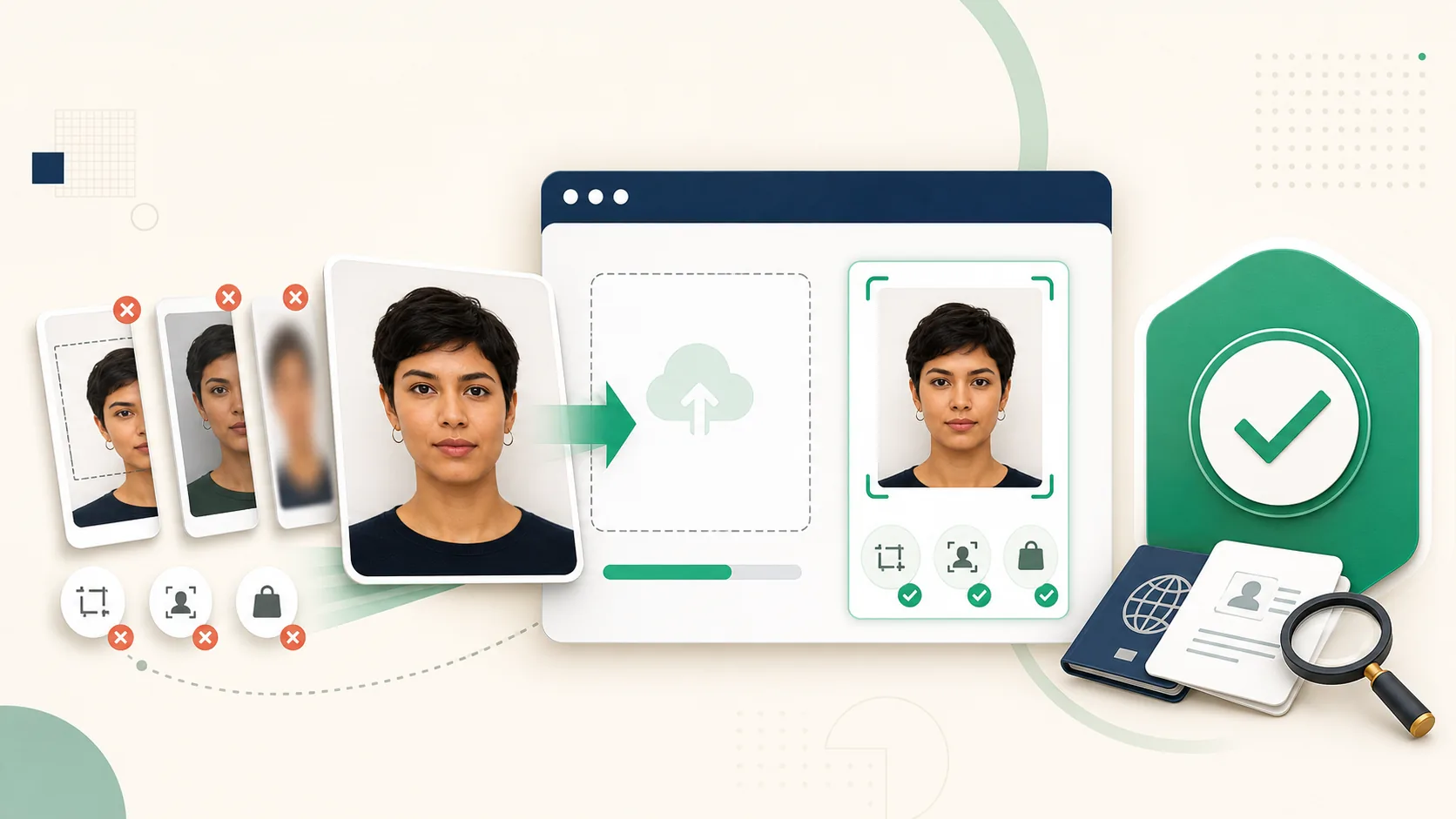
The Short Answer
We looked at more than 1,000 passport and visa photos run through our checker. About 1 in 3 (33%) failed at least one requirement on the first attempt — and the single biggest cause, by a wide margin, was head size and framing (23% of photos). Everything else — expression, lighting, head angle, file size — was in low single digits.
The surprise: the problem people worry about most, the background, almost never causes a failure at check time — because it's corrected automatically. What actually trips people up is the part only they control: how the photo is framed when it's taken.
What We Measured (and What These Numbers Are Not)
These figures come from more than 1,000 real photos submitted to our tool, scored against each document's official size, head-position, background, lighting, and file-size rules. We report the share of photos that failed each check on the first attempt.
Important: these are first-party tool-validation outcomes — how often a submitted photo fell short of spec before correction — not official government rejection rates. They're a useful map of where real photos go wrong, not a measure of any embassy's decisions.
The #1 Reason: Head Size and Framing (23%)
Crop, dimensions, and head height accounted for more failures than every other category combined. Photos came in with the head too large (face filling the frame), too small (too much body showing), or off-center.
This makes sense: every document specifies head height as a precise percentage of the image — often something like 50–69% — and that's almost impossible to judge by eye. It's also the one thing a background tool can't fix for you; it depends on how far you stood from the camera and how you cropped.
- Stand so your head and the top of your shoulders fill the frame, with a little space above your head.
- Shoot straight-on at eye level, not from above or at an angle.
- Don't crop tightly by hand — let a tool crop to the exact head-height ratio.
Everything Else Is Minor
After framing, the remaining failure causes drop off sharply. None of these individually came close to the head-size problem:
- Expression (e.g. mouth open, not neutral): ~4%
- Lighting (uneven or too dark): ~4%
- Head pose / angle (tilted or turned): ~3%
- File size or format (too large for the portal): ~2%
The Surprise: Background Is Almost Never the Problem
Background colour and shadows — the things most people stress about — caused essentially zero failures at check time. That's not because every photo had a perfect white wall. It's because the background is cleaned and replaced with the correct colour automatically before the photo is scored.
So if you've been avoiding a DIY photo because you don't have a plain white wall: that's the part you can stop worrying about. Spend your attention on framing and a neutral, well-lit, straight-on shot instead.
Which Documents Needed Fixing Most Often
Failure rates varied a lot by document — partly because of differing specs, partly because of how people photograph themselves for each. Among documents with a meaningful number of checks, the first-attempt fix rate looked roughly like this:
- Australia passport: ~65%
- Canada visa: ~53%
- Schengen (generic): ~50%
- US passport: ~36%
- UAE visa: ~31%
- US visa (DS-160): ~29%
- China visa: ~28%
- Japan visa: ~23%
How to Avoid Being in the 1 in 3
The pattern in the data is clear: get the framing right and you've cleared the biggest hurdle. Stand the correct distance away, shoot straight-on at eye level, keep a neutral expression, and use even front light. Then check the result against your document's exact requirements before you submit — the same specs our tool measures against — so a framing or file-size issue doesn't bounce your application.
You can check your photo for free: upload your photo, see the corrected preview and measurements, and only pay if you want to download the final file.
Frequently Asked Questions
What is the most common reason a visa photo is rejected?
In our analysis of 1,000+ photo checks, head size and framing was the #1 cause by a wide margin — about 23% of photos failed it on the first attempt. The head was too large, too small, or off-center relative to the document's required head-height ratio.
How often do passport photos fail on the first try?
Roughly 1 in 3 (about 33%) of the photos we checked failed at least one requirement on the first attempt — almost always something fixable, most often the framing or head size.
Is a white background the main thing that gets photos rejected?
No. Background and shadow problems caused virtually no failures at check time in our data, because the background is corrected automatically. The issues that actually fail are the ones you control when taking the photo — chiefly head size and framing.
Are these government rejection rates?
No. These are first-party tool-validation outcomes — how often submitted photos fell short of the official spec before correction — not measures of any embassy's or government's decisions.
Ready to Check Your Photo?
Use our AI-powered tool to ensure your photo meets all embassy requirements. Pay only when the preview passes — then download a document-ready file.